
Bois de Lauzelle
ICP Forests
The International Co-operative Programme on Assessment and Monitoring of Air Pollution Effects on Forests (ICP Forests) is a large-scale monitoring network designed to assess the impacts of air pollution, climate change and other environmental pressures on forest ecosystems across Europe and beyond, and to track their spatial and temporal dynamics. It was launched in 1985 under the UNECE Convention on Long-range Transboundary Air Pollution. The ICP Forest network currently covers more than 40 countries and combines two levels of observation: (i) Level I plots distributed according to a systematic grid and dedicated primarily to assessing tree crown condition, and (ii) Level II plots subject to more intensive monitoring, with measurements of various aspects of the ecosystem, such as atmospheric deposition, tree growth, foliar and soil chemistry, meteorology, and biodiversity.
Susceptibility to drought
The frequency and intensity of droughts and extreme heatwaves are increasing under climate change, leading to reduced tree vitality and, in severe cases, decline and increased mortality. European beech (Fagus sylvatica) is particularly sensitive to water stress. TreeWatch devices have been installed on three beech trees in the Bois de Lauzelle in Louvain-la-Neuve, close to a Level II ICP Forests plot located within the same stand. These instruments continuously monitor tree radial growth and sap flow, as well as soil water content and water potential at three different depths. The long-term dataset collected at the ICP Forests over nearly 30 years plot provides a valuable complement to the TreeWatch measurements, helping to better understand ecosystem functioning, notably in relation to water stress. Furthermore, the data from these three trees will also complement the measurements from TreeWatch units installed in 2025 on the same species at the ICOS site in Vielsalm, enabling a comparison of tree response to water stress under contrasting site conditions, notably in terms of climate and soil characteristics. These data collections are part of the “Plant Water Pump” project, supported by the European Research Council (ERC), the Earth and Life Institute of the Université catholique de Louvain (UCLouvain\ELI) and the FNRS. They will also be used to parametrize and evaluate the process-based forest growth and dynamics model HETEROFOR.
Beech (Fagus sylvatica)
Beech is native to temperature Europe, Asia and North America but only reached North-West Europe long after the ice age (ca. 2000 B.C.). It can reach heights of up to 40 m and an age of 200-300 year. Beech has a thin (1-2 mm), smooth and gray bark which is very sensitive to 'sun burn'. Flowers from April till May, around the same time that the leaves appear. Its fruits (beechnuts) are edible. Beech grows well in aerated, moist, calcareous and loamy soils. It does not tolerate high groundwater levels and poor sandy soils. Beech is a shade-tolerant climax species and is very competitive with oak (Quercus robur L.).
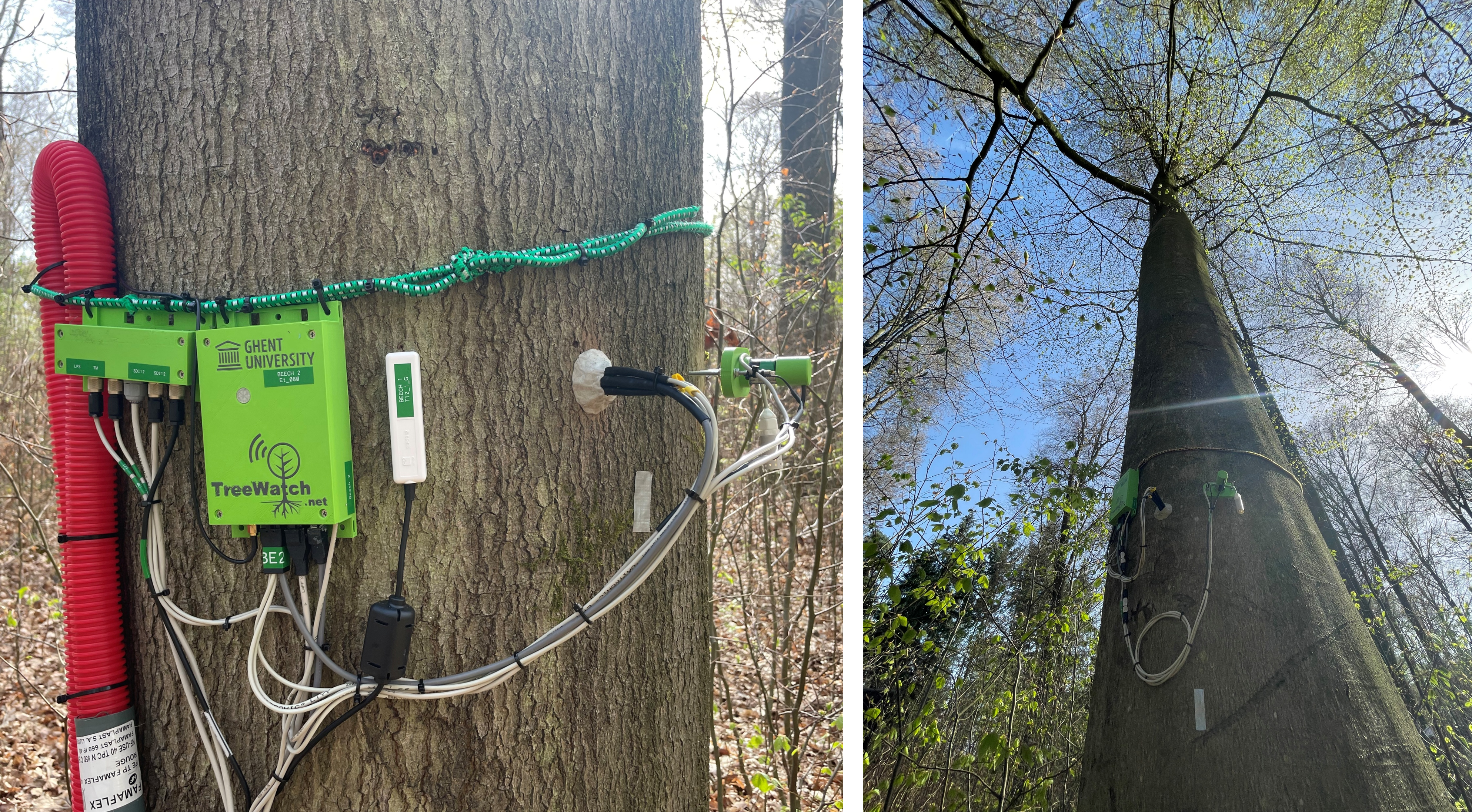
Tree location
The monitored Beech trees are located in the Bois de Lauzelle forest. The satellite image below shows the exact location of the monitored trees.